A Culture of Critical Comfort Zones
In July 2020, the anthropologist Bruno Latour is organising the exhibition The Critical Zones – Observatories for Earthly Politics (ZKM, Karlsruhe). This exhibition combines the work of several artists who express a concern for ecology and a common interest in the good of what Bruno Latour calls the ‘biofilm’ of the planet. Critical Zones are all natural environments endangered by the devastating activity of humans. In this exhibition there is a tension between human and responsibility as well as an attempt to twist – or re-entertwine – with nature and human.
I was inspired by this exhibition to create this sculpture Critical Comfort Zones. I think it is important to denounce our inability to invest in the ecological crisis. This incapacity can be explained – in my opinion – by the comfort that we have appropriated by enslaving and dominating nature. This comfort is of course necessary, to a certain extent, but today it makes humans blind and/or reluctant to change their excessive consumerism.
I invite the viewer to re-intertwine with nature. The chair calls for comfort – however – the fungi that emerges from the folds of the chair, like disturbing growths, prevent any form of passivity. The clay fungi, covered in red glaze, reveal the imbalance and cognitive dissonance within us.
The boundaries between nature and culture seem to melt into each other, to twist and melt into each other. Soon, they will no longer exist.
It is the Fungi that make us feel uncomfortable. For me, discomfort – though not pleasant – is absolutely essential in the process of change. Discomfort is important in order to bring about any kind of transformation. In our case, it is the mushrooms that create this discomfort and thus encouraging the viewer to challenge their approach and understanding of the natural world.
Moreover, the presence of mushrooms on a so-called ‘cultural’ object is all the more disturbing for the contemporary Western human. All the more so as the chair are objects that remain in the collective consciousness as an inescapable symbol of culture. The presence of the mushrooms – symbol of decay – on a chair – symbol of culture – deconstructs the nature/culture schism. Faced with Critical Comfort Zones, the spectator, if not able to sit down, is in discomfort. The viewer can ignore this discomfort by turning his back on the sculpture. Or they can force themselves to face their discomfort. The discomfort and the mushrooms can then bring about a transformation and in our case – a re-conception of the boundary between nature and culture.
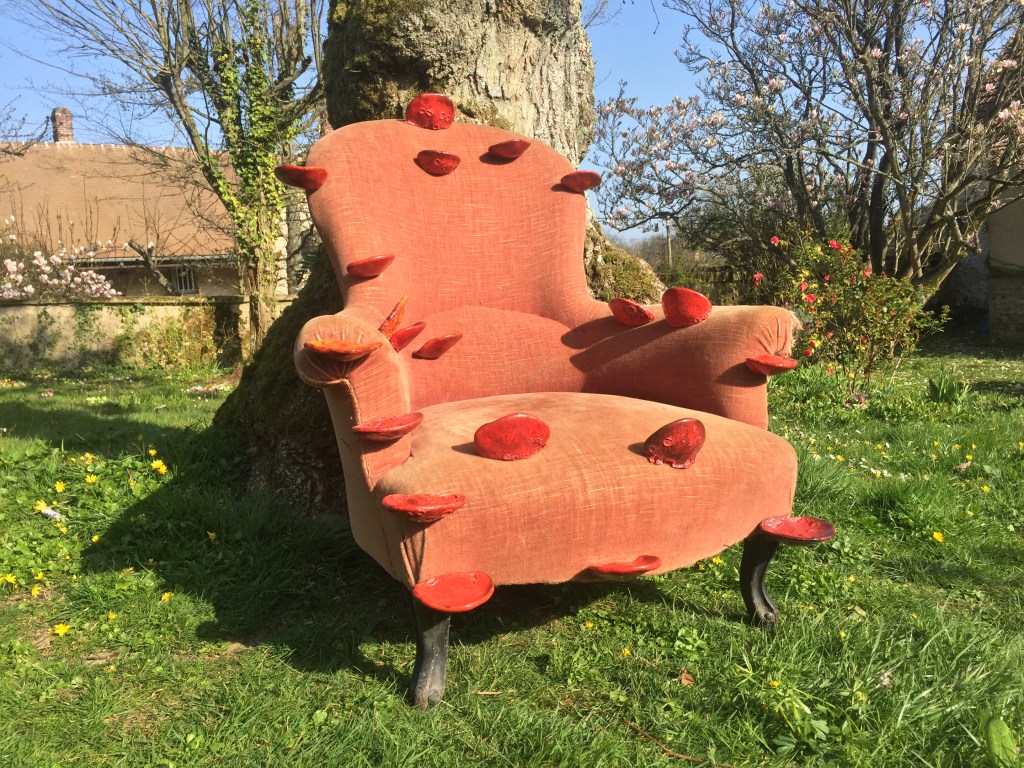
Emma Carter Millet, Critical Comfort Zones, (chair, clay and glaze), 2021.
Mushrooms allow us to rethink everyday objects and to question what we call ‘culture’. Here we can draw a parallel between my work, Critical Comfort Zones, and a work by the studio Klarenbeek & Dros. In 2019, the studio is exhibiting one of its works at the Centre Pompidou for the temporary exhibition La Fabrique du Vivant. 3, in 2019. This exhibition combines the work of artists and designers who question the living, its morphogenesis and its application in creative environments. The studio Klarenbeek & Dros will present the work Mycelium Chair, which the Centre Pompidou has subsequently acquired for its permanent collection.

Studio Klarenbeek & Dros, Mycelium Chair, mycelium and 3d printing, Centre Pompidou, 2019.
The Mycelium Chair was created with the help of a 3D printer and mycelium, which is the filamentous part of the mushroom. Unlike my work Critical Comfort Zones, the mushrooms are alive and integral to the composition of the work. Mycelium Chair has a strange beauty and envelops the viewer in a light, disturbing veil. The diversion of a cultural object into a natural one reveals the inevitable and dreaded contamination of culture by nature. Here, the disturbing diversion is illustrated by mushrooms and their ‘contamination’ of the seat.
However, in her book Mushrooms at the End of the World; On the Possibilities of Living in the Ruins of Capitalism, anthropologist Anna Lowenpaupt Tsing states in the Chapter entitled Contamination as Collaboration, “When contamination alters world-making projects, mutual worlds and new directions can emerge. Contamination is an integral part of life, we cannot escape its presence in our existence. Anna L. Tsing continues “everyone has a history of contamination: purity is not an option”. We can observe that in both Critical Comfort Zones, Mycelium Chair and Anna Tsing’s book, the mushrooms are entities that contaminate themselves. They contaminate each other and they contaminate the people who come into contact with them. I adopt the notion of contamination, as Anna Tsing understands it, that is to say as an interaction, an exchange that engenders a change and/or a transformation.
This transformation may be immaterial – like the changes in perspective imposed by the presence of mushrooms in Critical Comfort Zones and Mycelium Chair. Otherwise, a material and physical may take change place, as can be seen in the evolution of Mycelium Chair.

This website and the works by Emma Carter Millet & Thomas Clerc are licensed under a Creative Commons Attribution-NonCommercial-NoDerivatives 4.0 International License.
 Cultured Medium