Sympoiesis
Co-creating with the Living
This article is inspired by the evolutionary biologist Lynn Margulis’ book, entitled A Symbiotic Planet; A New Look at Evolution, in which she explores the notion of symbiosis and supports her hypothesis on Symbiogenesis. She defines symbiosis as “the cohabitation of different organisms”. In other words, symbiosis is co-existence and collaboration with species from different reigns of the living. Lynn Margulis defines Symbiogenesis as “an evolutionary term, [which] refers to the origin of new tissues, organs, organisms – even species – through the establishment of a long-term or permanent symbiosis”.
In her book, Margulis points out, “symbiosis is the system in which members of different species live in physical contact”. In echo with our last article, we observe that symbiosis is a deeply intimate biological phenomenon. It invokes interspecies contact, and thus a form of contamination. In other words, symbiosis requires a membrane to membrane entanglement between species. Symbiosis breaks down our notion of the individual and entangles the boundaries of living beings.
To illustrate this intimate relationship, Margulis uses the example of the symbiosis between Convoluta roscoffensis worms and cells of the alga Platymonas. The worms incorporate the algal cells when they are young. These cells produce food for the worm through photosynthesis. As a result, the adult worm has no mouth to feed and becomes completely dependent on the green algae for nutrition. The algae, on the other hand, have an environment that protects them and leads them to light – their food. The intermingling of these two organisms is “so intimate that it is difficult without very high-powered microscopy to tell where the animal ends and the algae begins”.
Symbiosis and Symbiogenesis are concepts that invoke interspecies collaboration. We – and all living things on this planet – are an entangled symbiosis. In her book, Staying with the Trouble, Donna Haraway introduces the term Sympoiesis. According to her definition, sympoiesis entails “building with, making with, doing with” other living species. Symbiosis, involves interconnection, interdependence, inter-collaboration with the beings that inhabit the planet. Sympoiesis is a co-creation, a becoming-with. This may offer us a new perspective and shed new light on our rapidly mutating world.
In this changing world, more and more creators are committing to create works in Sympoiesis with the living. This new creative perspective offers an inter-species co-creation with organisms such as Fungi and other micro-organisms.
Since the industrial revolution, the human species has been producing and accumulating non-degradable material waste at a rapid rate. As we all know, materials such as plastic do not take part in the cycle of organic matter on a human timescale. Non-degradable materials, as their names well indicate, have a hard time decomposing.
Consequently, a co-creation with Decayers such as Fungi and Bacteria would allow for art and design to be degradable and reintegrated in the cycle of organic matter. According to Donna Haraway, “We need unexpected collaborations and combinations taking shape in hot compost piles”. In other words, we need to create in Sympoiesis with the living in order to integrate creative production into the cycle of matter.
Let us take a look at an example of co-creation with Fungi, created by designer Aniela Hoitink. During an exhibition in the Netherlands called Fungal Futures in 2016, the designer exhibited a compostable dress from her MycoTEX series.
The dress is entirely composed, woven and structured by mycelium. The part of mushrooms that we know are the ‘Basidium’, the reproductive organs of the mushrooms. The mycelium is the perennial living part of it that grows in white and filamentous networks throughout the soil. These networks play an incredibly important role in soil biodiversity and ecology.
In our case, the mycelium acts as a binding textile and literally composes the work. Human and fungal membranes intermingle and intertwine. This co-creation, is both composed and decomposed by the Fungi, fundamental Decayers of the living.
I argue that if our changing world is to remain habitable, we need to rethink the production of our waste and therefore the process of creation. Artists and designers can re-imagine their creative conception through a mode production in Sympoiesis with the living. Grown and cultivated artworks are ephemeral works that reduce waste and contribute to the cycle of organic matter.
In line with this reflection, we decided to create a mundane object in co-creation with the mushroom Pleurotus ostreatus. The work is part of a series of everyday objects, entitled The Compostable series.
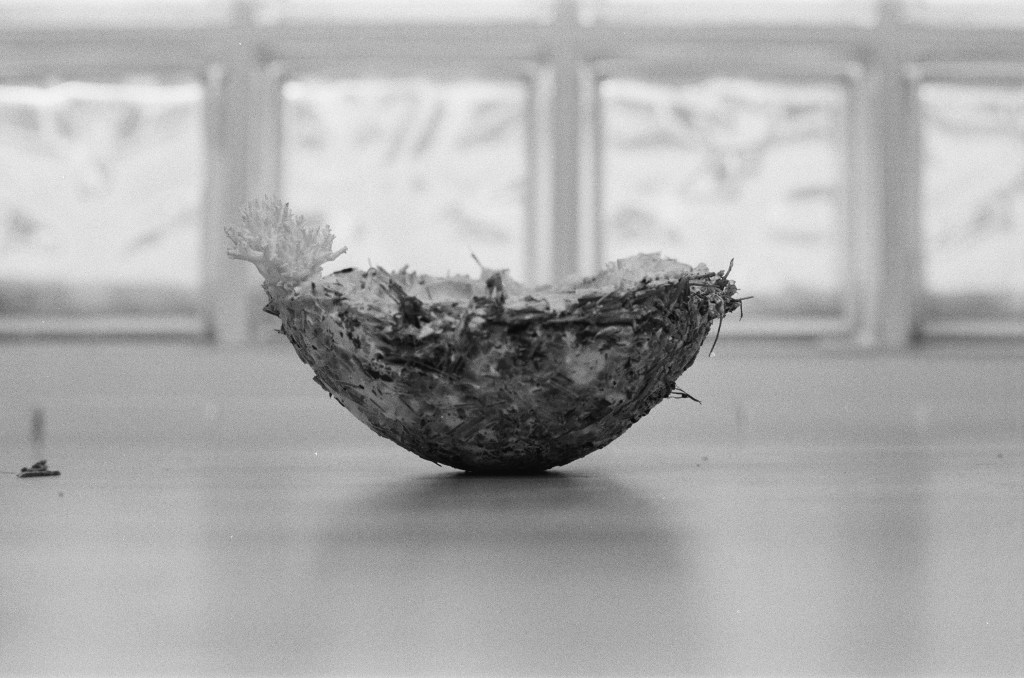
Emma Millet, Thomas Clerc & Pleurotus ostreatus, Compostable series, (straw and grey oyster mushroom mycelium), variable dimensions, 2021.
Composed with straw – the substrate or fibrous food for Pleurotus ostreatus – the series is a collaboration with the grey Oyster mushrooms. The spores of the fungus and straw are moulded and folded into the desired shape. The mycelium then take about two weeks to colonise and bind the straw together. After these two weeks, the fruiting body of the mushroom begin to sprout and erupt from the piece.
There are two possible outcomes for a Compostable object. On the one hand, the fungus can be made to grow by keeping the object in a damp, bright place. Eventually, the mushrooms will have been eaten and the artwork will begin to decay. On the other hand, the object can be dried and used as a functional object. Whatever the choice of fate, after its use, an object from this series will be composted, degraded and digested by Decayers.
In 2019, Studio Klarenbeek & Dros, based in the Netherlands, exhibited it’s 3D printed Mycelium Chair at the Centre Pompidou in the temporary exhibition entitled La Fabrique du Vivant Mutations/Créations 3. The exhibition press release states that “the printed product can be composted after use”.
In 2010, the design and research studio Officina Corpuscoli studio developed the project Continuous Bodies – The Ephemeral Icon. The work explores the degradable possibilities of an everyday object that embodies a society of relentless consumerism : the Monobloc plastic chair. On the Studio Officina Corpuscoli website, we can read that this chair is “a clear symbol of the limited life expectancy that characterises most consumer products, in direct opposition to the ‘immortal’ qualities of the materials from which the majority of consumer products are in fact made”. In this case, immortal is another word for non-biodegradable.
With the use of “the Mycelium Bio Cover”, the immortal icon becomes ephemeral. The Mycelium Bio Cover is a felted wool blanket inoculated with mushroom mycelium. Over time, the plastic chair is slowly degraded by the mycelium. By incorporating Decayers, the immortal plastic chair is re-integrated into the cycle of matter.
According to the Officina Corpuscoli’s website, “Once the plastic chair is fully colonised, users can safely dispose of it by placing it in the garden or literally burying it in the ground, making it a natural fertiliser for the soil and a safe nutrient for the growth of new life”. In this sense, the plastic chair becomes – in the words of Donna Haraway – a “creature of the mud”.
References
Donna Haraway, Vivre avec le trouble, Traduit par Vivien Garcia, Vaulx-en-Velin, Éditions des mondes à faire, 2020.
Lynn Margulis, A Symbiotic Planet; A New Look at Evolution, London, Weidenfeld & Nicolson, 1998.
Websites
Officina Corpuscoli, The Ephemeral Icon, [En Ligne], Published in 2010, Consulted the 21 Janvier 2022, Available : https://www.corpuscoli.com/projects/the-ephemeral-icon/
Exhibition, La Fabrique du Vivant, Mutation et Création, Centre Pompidou, 2019. Press Release, PDF.
 Cultured Medium