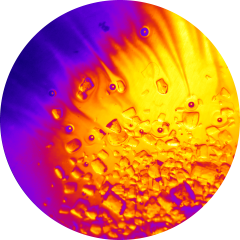
A Matter To Digest
In her book A Symbiotic Planet, biologist Lynn Margulis describes the process of symbiosis as an incorporation of individuals. Lynn Margulis points out that the living beings still present today “have remained in the game of life because they become individuals by incorporation “. This is not a narrative of host and parasite but rather one of several symbionts that become-with in order to survive together. Donna Haraway states that “microbes interpenetrate, they circle each other and pass from one to the other, they eat each other, digest each other, have indigestion and partially assimilate “.
The concept of a Cultured Medium is a living media which is cared for and carefully cultivated. The medium is a form of food which is cultivated by either Humans and/or Decayers (i.e Fungi, Bacteria etc…) Similarly to us, a cultured medium needs to be nurtured in order to grow and develop. In return, these cultivated environments can provide food for thought, fuel for our imaginations and give us matter to digest.
In connection with the questioning of incorporation and interpenetration, we have developed a project entitled Comestible Series (2021). This series of works is a growing medium co-created with the ascomycete fungus of the genus Aspergillus oryzae, which is edible, domesticated by humans and used in cooking.
This Fungi is the basis of renowned umami tasting foods such as miso and soy sauce. It can also be eaten like tofu or tempeh. The cultivated medium of this edible fungi becomes known as koji. Aspergillus oryzae feeds on pre-cooked cereals. To grow and cultivate the artwork, we prepared a barley medium for the Fungi, then inoculated it with Koji spores. After 48 hours, at a temperature of 30 degrees Celsius and 70% of humidity, the Fungi grows and fuses the barley grains together.
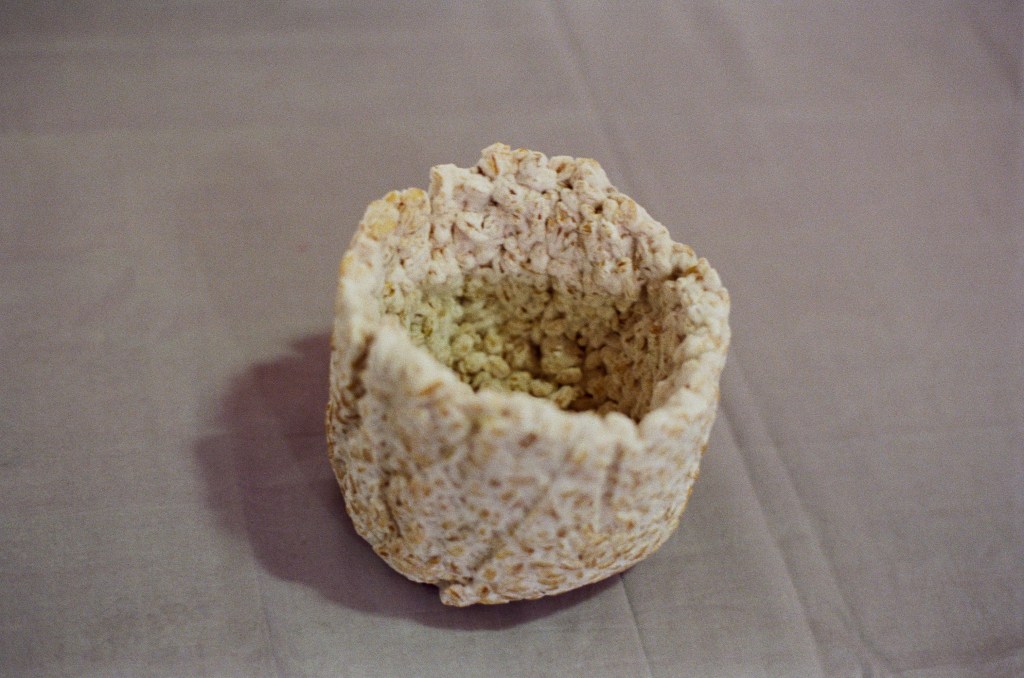
Emma Millet, Thomas Clerc & Aspergillus oryzae, Comestible Series, (barley, Aspergillus oryzae spores), variable dimensions, 2021.
Using koji as an artistic medium, we moulded a whole series of everyday objects linked to nutrition such as plates, bowls and pots. The Comestible Series (2021) explores the incorporation of the works by the Spectators. Viewers of this cultured medium are invited to touch, break off pieces of the edible sculptures and are even encouraged to take these pieces with them so that they can cook and eat the koji at home. The Comestible Series is an interactive work that seeks to shatter the myth of the fixed, immortal, untouchable and unshakeable artwork.
In order to close the cycle of matter, these pieces are incorporated, ingested and digested by the viewers. In my opinion, experiencing any work of art is an invitation to incorporate a new form of imagination. Edible cultured mediums fuel reflections, cultivate the intellect and nourish the imagination (and bodies) of their audience.
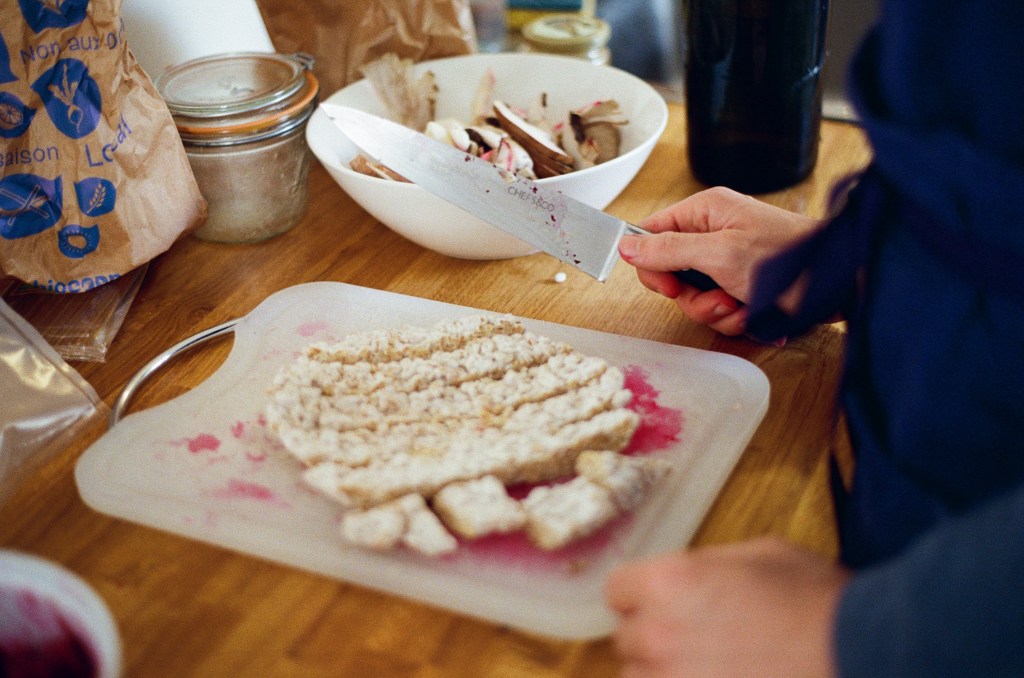
Emma Millet, Thomas Clerc & Aspergillus oryzae, Comestible Series, (barley, Aspergillus oryzae spores), variable dimensions, 2021.
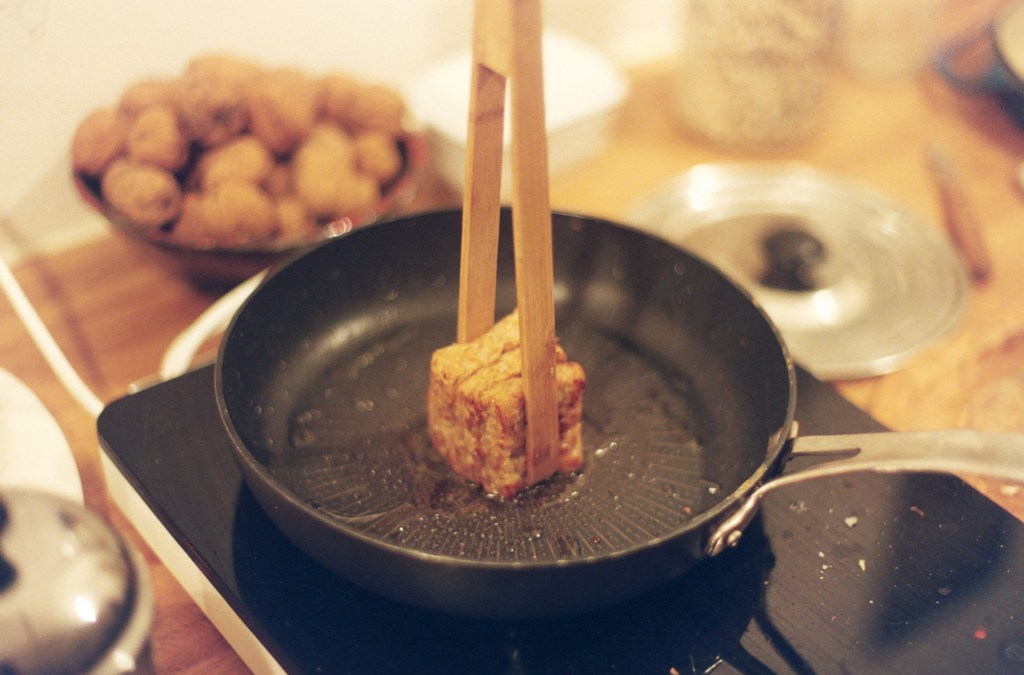
Emma Millet, Thomas Clerc & Aspergillus oryzae, Comestible Series, (barley, Aspergillus oryzae spores), variable dimensions, 2021.
In his book Metamorphoses, the philosopher Emanuele Coccia writes in a chapter entitled Food and Metamorphoses: “For most of us, it happens at least three times a day, and yet we hardly notice it. It doesn’t matter whether we’re talking about plants, animals or mushrooms. Every day, we have the habit of sitting down and using our hands and mouths to literally incorporate the bodies of other living beings: to take their life, take their bones, their flesh and transform them into our life, our bones, our flesh. ” In a sense when we incorporate and digest these edible works, we transform them into our own body and flesh.
Emanuele Coccia further develops the following definitions of the terms nutrition and food. On the one hand, it “is proof that life is infinitely malleable and ready for anything, that the body of life and of the living can never be confined within a domestic and proprietary logic: it is nothing more than the infinite transmigration of matter “. On the other hand, “food – that is to say, the most common and repeated form of metamorphosis – is also the evidence that death cannot be thought of as the opposite of life: it is the passage of life common to everyone from one form to another”.
Let us now turn to another edible project. In 2013, as part of the exhibition Grow Your Own at the Science Gallery in Dublin, Ireland, biologist Christina Agapakis and odour expert Sissel Tolaas cultivated their own living work entitled Selfmade. This growing medium questions the relationship between Humans and Decayers in a culinary dimension. The work’s medium is milk, and its Decayers are lactic bacteria and fungi of the genus Penicillium. Christina Agapakis describes cheese as “carefully rotten milk”, or in other words, carefully cultivated media.
For the Grow your Own exhibition, the biologist decided to hijack the dairy product. In an article published in National Geographic, entitled “‘Human Cheese’; Only the first course for Odd Cheeses”, biologist Chelsea Huang explains that the research team was surprised “to find a lot of information about the number of microbial species that make sweat or feet smell the way they do are closely related to the species that make cheeses smell the way they do. These links were surprising and really interesting from the point of view of what is culturally ‘good’ or ‘bad’”.
To produce the work, “biologist Christina Agapakis and odour expert Sissel Tolaas extracted bacteria from the navels, feet, mouths and tears of artists, writers and cheesemakers to create ‘human cheeses”. Christina Agapakis’s culture medium both disturbs and fascinates. Agapakis’s cheese is contaminated with fungi from the human skin and although nowhere is it stated that this cheese has been eaten, its very existence suggests ingestion. Finally, with Selfmade, biologists Christina Agapakis and Sissel Tolaas cultivate an inter-species intimacy and shake the boundaries between Humans and Decayers.
Like symbiosis, the process of nutrition by incorporating one body into another questions the notion of the individual as a unique being. Emanuele Coccia states that “to stay alive, one must cross the limits of one’s own body and allow these same limits to be crossed “, he adds further on in his text: “No species can limit itself to inhabiting its own body. It is obliged to enter the carnal home of the other, to occupy it, to integrate into it, to become the body of the other, the flesh of other species”. Any process of feeding and nutrition invites an individual to transcend the boundaries of her own body and incorporate the body of another. The boundaries between individuals begin to shatter and dissipate.
References
Lynn Margulis, A Symbiotic Planet: A New Look at Evolution. London, Weidenfeld & Nicolson, 1998.
Donna Haraway, Vivre avec le Trouble, Vaulx-en-Velin, Éditions des mondes à faire, 2020.
Emanuele Coccia, Métamorphoses, Paris, Éditions Payot & Rivages, 2020.
Christina, Agapakis, « Toe Cheese », [Published 2013, PopTech, 5:33 min], Consulted le 13 avril 2021, Available : https://www.youtube.com/watch?v=BQ-9-HAyAH0
Chelsea, Huang, « Human Cheese ; Only the first course for Odd Cheeses », National Gepgraphic Culture, [Published in 2013]. Consulted 12 avril 2022, Available : https://www.nationalgeographic.com/culture/article/131202-human-cheese-food-biology- weird-gastronomy
 Cultured Medium