Enter the Maerl Matrix of Ireland
This article was originally written in the framework of the MPhil Environmental History at Trinity College Dublin, by Emma Millet.
On the 27th of February 2024, the Nature Restoration Law (NRL) was passed by the European Union Parliament. Indeed, we have come to a point where protecting vulnerable marine ecosystems is no longer enough – restoring them is now critical too. The NRL focuses on seven main marine habitats to prioritise until 2030. These include: 1. Seagrass Beds, 2. Macroalgal Forests, 3. Shellfish Beds, 4. Maerl Beds, 5. Sponge & Coral Beds, 6. Vents & Seeps and 7. Soft Sediment. Most of these habitats are overall well known to the general public, but one caught my eye: maerl.
What exactly is maerl and why does it need to be protected and restored under EU Law ?
The name ‘maerl’ is thought to come from Brittany, France, where maerl beds are abundant along the coastline. Although few know it by name, some of you may recognise maerl’s exoskeleton present on certain beaches, as pictured below.
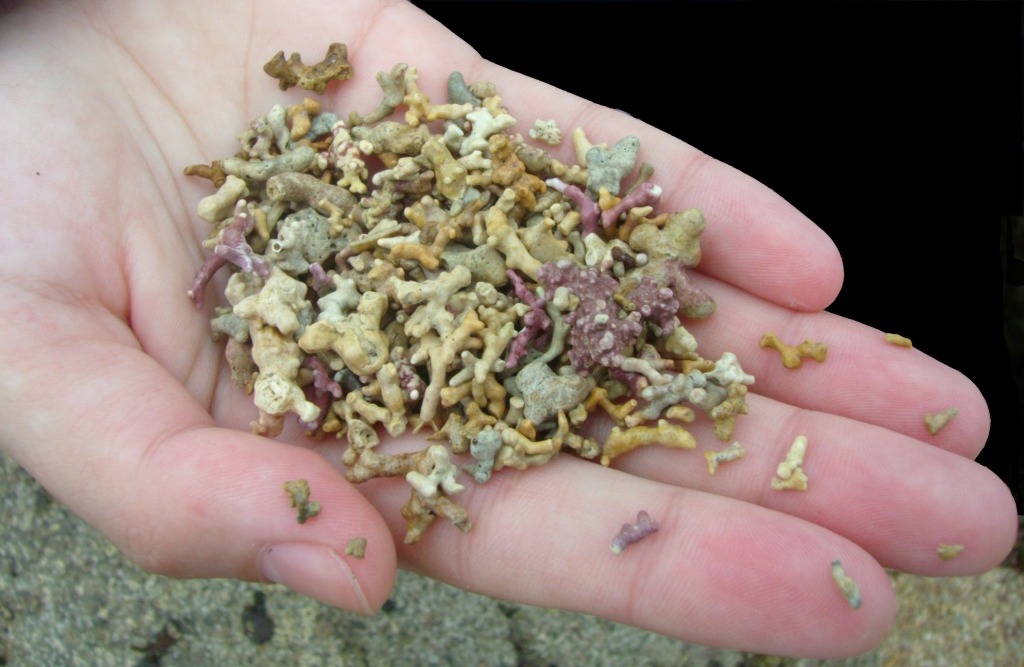
Maerl fragments, Trá an Doilin, Maerl Beach (incorrectly known as “Coral Strand”) Carraroe, County Galway, Ireland. By Emkaer. CC. 03.
These special beaches are known as ‘coral strands’. Remarkably, although maerl looks just like coral, it is in fact seaweed. It is part of a group known as coralline algae that contain high levels of calcium and magnesium. This is what gives the maerl its calcified, coral-like appearance. Maerl grows on the sea-floor in dense networks, known as the maerl matrix. This matrix mat is a mix of both dead and live maerl. The living maerl is found on the top of the entangled structure as live organisms need light in order to photosynthesise. In this respect, maerl is particularly sensitive to water turbidity and sedimentation. In other words if covered up, they die. Maerl habitats are found in European waters, the Mediterranean and the Arctic but especially in Brittany, Scotland, Britain and Ireland along the Atlantic Coast. As for us, we will be focusing on the maerl matrix of Ireland.
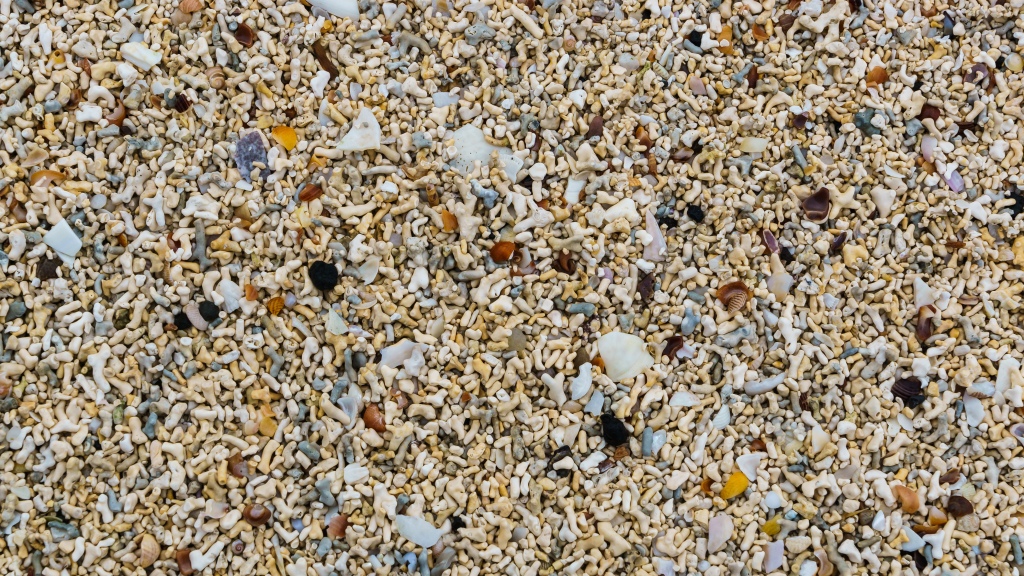
Calcified remains of maerl, on the “coral beach” in the Isle of Skye. © User:Colin / Wikimedia Commons / CC BY-SA 4.0
Maerl habitats are formed by the accumulation of both dead and living organisms on the seafloor. A research done on the beds of Scotland has shown that pristine live maerl habitat are crucial nursery areas for commercial fish and molluscs. These healthy maerl beds constitute nurseries to queen scallops (Aequipecten opercularis) and other invertebrates, such as the soft clam (Mya arenaria) and sea urchins (Psammechinus miliaris), more effectively than damaged or dead maerl. Live and thriving maerl habitats are an oasis of biodiversity, sometimes harbouring rare species unique to a specific maerl bed.
However, according to scientists, even dead maerl or ‘dead debris’ remains an important habitat for particular seaweeds. Further research shows that ‘dead debris’ remains an important habitat for other species too. Sea cucumbers seek the protection of dead maerl beds and some species burrow into ‘dead debris’ up to 60cm or deeper. We could choose to call these characteristics of maerl beds ‘ecosystems services’ for humans – or we could simply acknowledge that these habitats are crucial for the welfare of marine biodiversity.
Maerl has been crucial to marine fauna for millennia. It is a long-lived and slow growing organism. It is thought to be able to live up to 8000 years and yet only grows about 1mm per/year. According to scientists from the Marine Institute in Galway, this makes maerl an environmental archive. Just like tree rings, scientists can read maerl to identify changes in ocean salinity, acidity and temperature, allowing for insights on past environmental and climatic conditions. Furthermore, as maerl is a calcified algae, its body is full of carbon. This effectively makes maerl beds incredibly important carbon sinks – under the fundamental prerequisite that they are not disturbed.
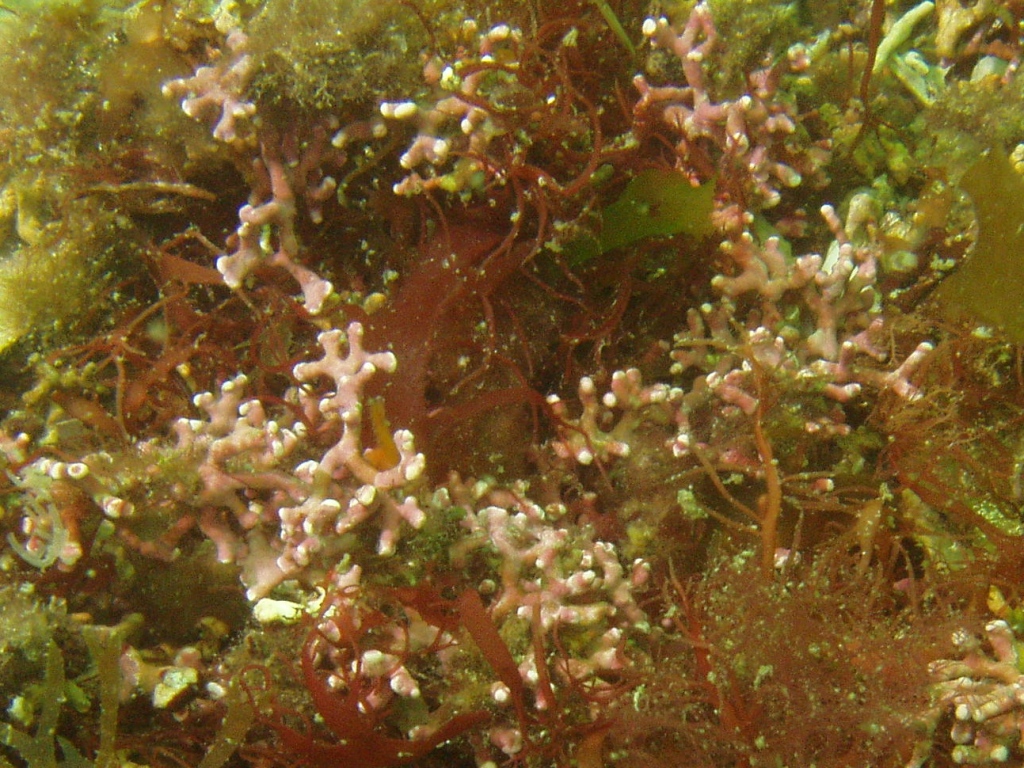
Live maerl, a coralline algae. By ArranCOAST, CC BY-SA 3.0
Of course, like other marine habitats, maerl beds are disturbed and threatened in many different ways. One of the main threats to maerl is the acidification of the oceans, linked to anthropogenic climate change. Indeed, high emissions of CO2 react with H2O and increases ocean acidity. If one were to drop an egg in a glass of vinegar, the calcium-rich eggshell would begin to soften. This is exactly what happens to maerl when it dwells in acidified seas. Scientists have predicted that if the rising acidity of oceans is not controlled, maerl beds could disappear in the next 100 years in Ireland. The other main threats to maerl habitats include: waste water, mariculture, fisheries and extraction. Research has found that the most important threats among these are the last two, notably linked to bottom trawling practices and maerl extraction. As mentioned above, maerl are photosynthetic beings. If they are smothered by sediments while commercial dredges are dragged on the seafloor or when maerl extraction is performed, they cannot survive. The paradox is that the maerl matrix is a nursery for commercial fish and molluscs. Bottom trawlers take part in the destruction of the very habitat that support their fisheries.
Throughout the 20th century, maerl was found to be an excellent fertiliser and was extracted extensively. While maerl extraction is now highly restricted and sometimes forbidden in Britain and France, it is still performed in Ireland. A company named Celtic Sea Minerals has a license to mine 5000 Tonnes per/year of the sub-fossil maerl beds in Bantry Bay, to produce calcium rich supplements for stockfeed. It is our understanding that this particular bed does not contain any live maerl. However, the information mentioned above allows us to ascertain that dead maerl habitats are not devoid of other living species. Seabed extraction does not allow for considerate harvesting. Furthermore, on their website, Celtic Sea Minerals state that their marine mineral products produced from the mined maerl is “truly sustainable and supports the global agriculture sustainability goals to feed the future world population in a responsible way”. The irony of this statement is splendid as there is nothing remotely sustainable in either industrial farming nor harvesting maerl beds that take thousands of years to grow.
All in all, Ireland has done much to protect its maerl beds over the last decades. The Marine Research Institute in Galway has worked on protecting and mapping maerl beds throughout the territory with projects such as Infomar. However, more needs to be done to raise awareness and literacy in order to further protect the maerl matrix of Ireland.
References
DE GRAVE, S. Fazakerley, H. Kelly, L. Guiry, M. D. Ryan, M. & Walshe, J. (2000). A Study of Selected Maërl Beds in Irish Waters and their Potential for Sustainable Extraction. [Online]. Galway : Marine Institute. Pages 3-35. Available at : https:// oar.marine.ie/handle/10793/209. [Accessed 29/03/2024].
DE GRAVE, S. Whitaker, A. (1999). “Benthic community re-adjustment following dredging of a muddy-maerl matrix”. Marine Pollution Bulletin. [Online]. Volume 38, Issue 2. Pages 102-108. Available at : https://www.sciencedirect.com/science/article/pii/ S0025326X98001039. [Accessed 04/04/2024].
KAMENOS, N. Moore, G. Hall-Spencer, J. (2004). “Nursery-area function of maerl grounds for juvenile queen scallops Aequipecten opercularis and other invertebrates”. Marine Ecology Progress Series. Vol. 274, Pages 183–189.
MALCOM, R. C, Rowden, A. Schlacher, T. Williams, A. Consalvey, M. Stocks, K. Rogers, A. O’Hara, T. White, M. Shank, T. Hall-Spencer, J. (2010). “The Ecology of Seamounts: Structure, Function, and Human Impacts”. Annual Review of Marine Sciences. [Online]. Volume 2, Issue 1. Pages 253-278. Available at : https://pearl.plymouth.ac.uk/handle/ 10026.1/1339. [Accessed 29/03/2024].
SHEEHAN, E. V. Bridger, D. Cousens, S. L. Attrill, M. J. (2015). “Testing the resilience of dead maerl infaunal assemblages to the experimental removal and re-lay of habitat.” Marine Ecology Progress Series. Volume 535. Pages 117-128.
VERMA, A. Van der Wal, R. Fischer, A. (2017). “New Technological Interventions in Conservation Conflicts: Countering Emotions and Contested Knowledge”. Human Ecology Interdisciplinary Journal. [Online]. Volume 45, Issue 5. Pages 683-695. Available at : https://www.ncbi.nlm.nih.gov/pmc/articles/PMC5680367/ [Accessed 30/03/2024].
WISON, S. Blake, Ch. Berges, J. Maggs, Ch. (2004). “Environmental tolerances of free- living coralline algae (maerl): implications for European marine conservation”. Biological Conservation. [Online] Volume 120, Issue 2, Pages 279-289. Available at : https:// http://www.sciencedirect.com/science/article/pii/S0006320704000977. [Accessed 29/03/2024].
Websites
CARR, Grace. (2024). EU Nature Restoration Law, A Deep Dive. [Online]. Available at : https://fairseas.ie/2024/03/11/eu-nature-restoration-law-a-deep-dive/. [Accessed 28/03/2024].
CELTIC SEA MINERALS. (2020). Marine Minerals. [Online]. Available at : https:// celticseaminerals.com/marine-minerals/. [Accessed 29/03/2024].
GUIRY, M. D. (2020-2024). Irish Maerl. [Online]. Available at : https://www.seaweed.ie/ uses_ireland/irishmaerl.php. [Accessed 30/03/2024].
INFOMAR. (2023). INFOMAR releases five new high-resolution maps showcasing the Cork coastline in unprecedented detail. [Online]. Available at : https://www.infomar.ie/node/570. [Accessed 04/04/2024].
OSPAR Commission. (2019). Maerl Beds. [Online]. Available at : https://www.ospar.org/ work-areas/bdc/species-habitats/list-of-threatened-declining-species-habitats/habitats/ maerl-beds. [Accessed 29/03/2024].
OSPAR Commission. (2019). Status Assessment 2019 – Maerl Beds. [Online]. Available at : https://oap.ospar.org/en/evaluations-ospar/evaluations-des-comites/biodiversite-et- ecosystemes/evaluations-detat/maerl-beds/ [Accessed 02/04/2024].
 Cultured Medium